PCB assembly (PCBA): frequently asked questions answered by VRI
What is PCB assembly (PCBA)
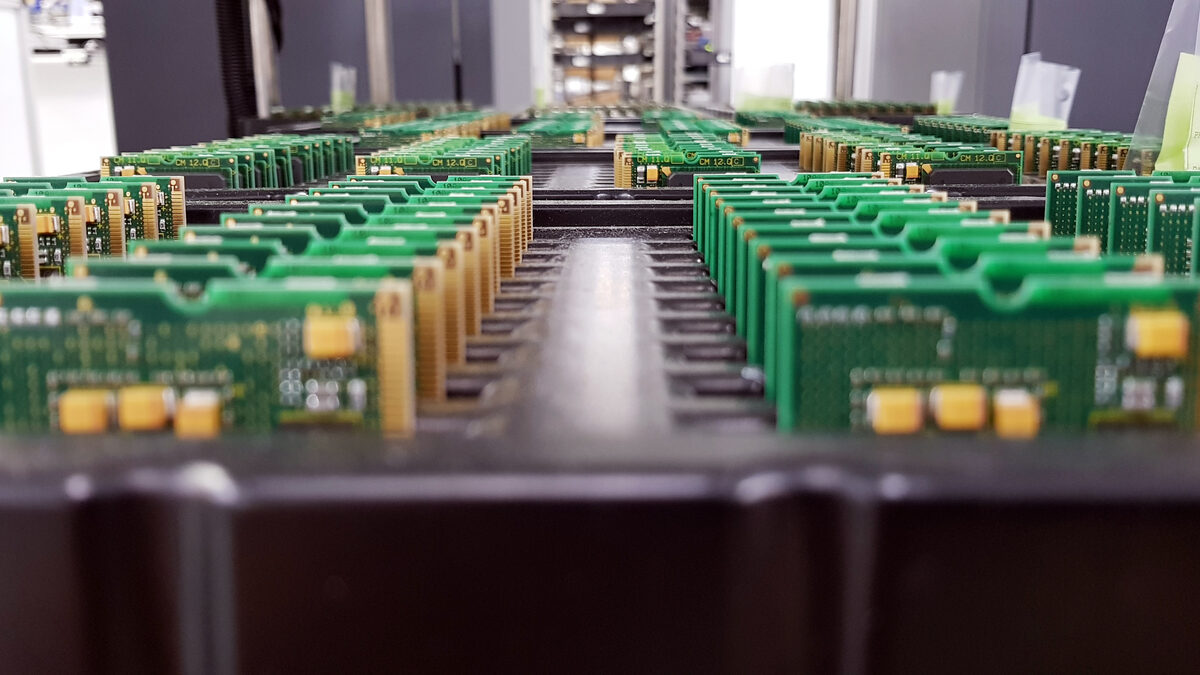
PCBA (Printed Circuit Board Assembly) is the process of populating a printed circuit board with its components and turning it into a functional product. VRI Indústria Eletrônica, a Brazilian EMS founded in 1991 and headquartered in Campo Mourão (PR), runs this process under a quality system certified to ISO 9001 and ISO 13485, serving regulated sectors that don't tolerate failure — medical, elevators, agricultural, banking automation, industrial, defense and space.
Below are the most common questions from those about to build boards with us.
Files and documents
Which files do I need to send for a PCBA quote?
To quote and build your assembly, send:
- - Gerber files (or ODB++) with the copper, mask and silk layers
- - Centroid file (also called Pick & Place or XY data)
- - BOM (Bill of Materials) with reference, manufacturer and part number
Optional but very helpful: an assembly drawing, special instructions and reference product photos. They reduce ambiguity and prevent placement errors.
What is the Centroid file?
It is the file that programs the pick & place machine. For each SMD component it lists the reference designator, the X and Y coordinates, the rotation and the board side (top or bottom). Through-hole components are placed in a separate step.
Components and sourcing
Does VRI buy the components for me (turnkey)?
Yes. VRI works both with consigned material (you provide the parts) and with component sourcing in a turnkey model. Whenever there's a question about specification, availability or the need for a substitution, the approval is always yours before moving forward.
Is there a minimum order quantity (MOQ)?
VRI serves from prototyping to series production. The ideal minimum volume depends on the project, the components and the assembly type — the sales team assesses the best format for your case.
Assembly technologies
Does VRI assemble BGA and fine-pitch components?
Yes — VRI assembles advanced packages, including BGA, with process control and automated optical inspection (AOI). For hidden joints, the correct via treatment (filled via-in-pad, capped via near pad) is essential for solder quality and is part of the engineering care in the board design.
Is the assembly RoHS compliant?
Yes. VRI performs lead-free (RoHS) assembly and also soldering with traditional processes when the project requires it. Just state the requirement in the quote.
Layout and preparation
Why does my board need panelization?
Panelization (arranging several boards in an array) makes SMT-line processing easier, especially when the board is small or has a non-rectangular shape. Since VRI also handles PCB fabrication, the panel and stencil are prepared in an integrated way with the assembly.
Quality and testing
Which tests are performed on the boards?
Depending on the project, VRI performs:
- - Visual inspection
- - Automated optical inspection (AOI)
- - Electrical testing and burn-in
- - Functional testing, when specified by the customer
Which quality standard does VRI follow?
VRI maintains ISO 9001:2015 (since 1998) and ISO 13485:2016 for medical devices (since 2017), and operates per the IPC-A-610 (electronics) and IPC-620 (cables and harnesses) standards — an IPC Association member since
- 2007. The entire production area is protected against electrostatic discharge
(ESD), with batch traceability of raw material via individual barcodes.
Does VRI do conformal coating?
Yes. Conformal coating is part of the portfolio, alongside electrical testing, burn-in, product integration, cabling, prototyping and project updates.
Lead times and lifecycle
When does my order's lead time start counting?
The lead time starts when all parts and PCBs are available and all files (Gerber, Centroid, BOM and supporting documents) have been delivered and validated. In turnkey orders, part of the lead time depends on component purchasing — which is why PCB fabrication and stencil preparation run in parallel.
Does VRI redesign obsolete components?
Yes. VRI redesigns and updates projects for end-of-life (EOL) components, including reverse engineering and drop-in replacement. It's a way to reduce obsolescence risk without redesigning the whole product.
Conclusion
From prototyping to production, VRI brings engineering, PCB fabrication, component sourcing and assembly under one roof — with batch traceability and a certified process for sectors that don't tolerate failure.
Have a project in hand? Request a quote or talk to our sales team.